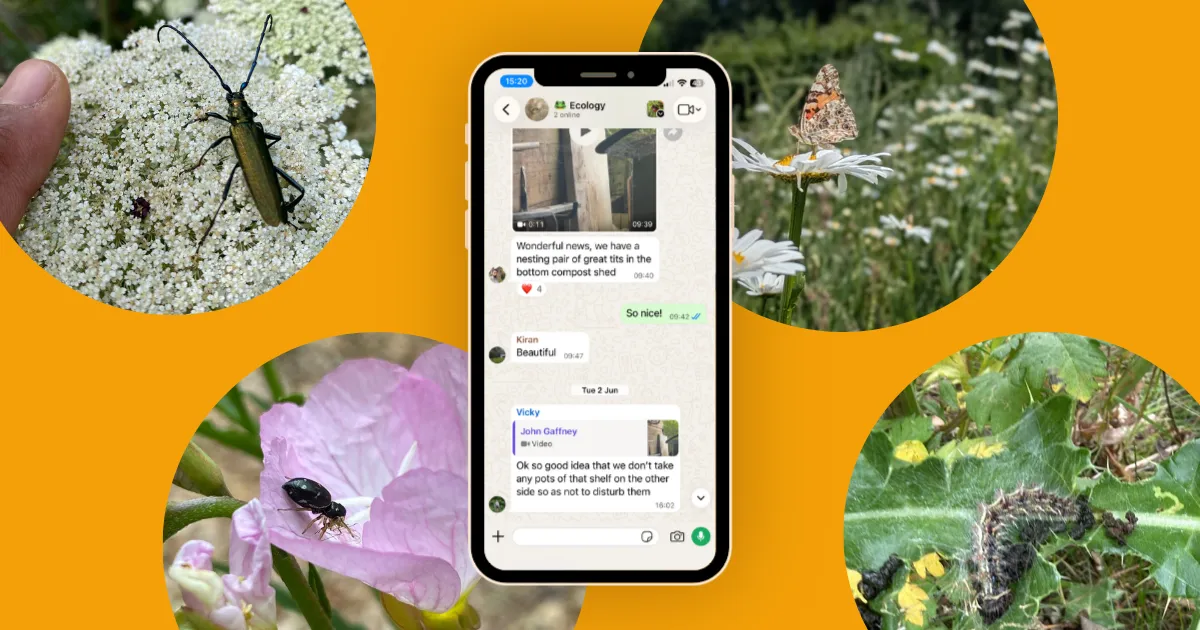
OmVed Ecologist Kiran Lee reflects on a month of wildlife sightings shared across the garden team's WhatsApp chat—and makes the case that our emotional reactions to nature are just as vital to conservation as the data we collect.
John:“Wonderful news, we have a nesting pair of great tits in the compost shed”
Joanna:“So nice!”
Kiran: “Beautiful”
Vicky: “Ok so good idea that we don’t take any pots of that shelf on the other side so as not to disturb them”
My favourite WhatsApp chat, “OmVed 🐸Ecology”, during my favourite month of the year, June, has come alive. It is our work chat comprising a multidisciplinary group of artists, educators, growers, landscapers and ecologists, that have a shared interest working with the garden. We share stories, anecdotes, images, videos of all more-than human wildlife observations. I am grateful and excited to see what goes on when I am not present on site and it provides an excellent, passive form of ecological monitoring. June’s edition recounted sightings of: great tits, wood pigeons, wrens, that were all busy nesting; painted ladies and hummingbird hawk moths flitting between flowers, and; a musk beetle (found during a Highgate Primary School Year 3 pollinator bug hunt) and a lesser stag beetle, both mighty heavyweight beetles. I was fascinated to later discover that the musk beetle needs to spend up to three years eating and living in willow, particularly coppice trees which we have near the pond. There was also a brief sweep net from Noel Brock and Michael Holland finding: candy-striped spider, bishop’s mitre bug, tortoise beetle, picture-winged fly and dock bug.
Sometimes my favorite records aren’t the species themselves, but the human ripples they leave behind: the comments, and reactions of the people tending this land. Our collective emotional enthusiasm details a value that is nearly impossible to quantify on a standard spreadsheet, yet it is the ultimate driver of conservation. We tend what we love. I think the above message exchange between John, Joanna, Vicky and myself, encapsulates well the cycle of noticing, recording, reacting and then tending the tits that is important in conservation. In traditional academic biology, ecological surveys are often designed to filter out human noise, reducing the living world to counts, codes, and population abundances. These numbers are useful for tracking baseline changes in our environment. Indeed, we keep a running inventory of all birds, flowers, trees and identifiable invertebrates on site to monitor the ecological health of our garden. But relying exclusively on these counts suggests that we humans are objective, outside observers of nature. By treating data and human emotion as complementary, not contradictory, we create a truer record of the land. The counts tell us if a species is surviving and our stories and reactions tell us how we are actively choosing to live alongside them.
Written by Kiran Lee

Want to experience the creative expression of ecology? You can find examples of our upcoming creative events that respond directly to the living world here.