The story of how landscape architect and designer Paul Gazerwitz led the healing of a neglected, polluted space with care, facilitating a sympathetic rewilding. Aided by architectural interventions and site design from HASA Architects and final development and design by Smerin Architects, OmVed Gardens has become a destination to explore the connections of food, creativity and ecology for health, climate resilience and community making.

It started with a seed. On the site of a tarmacked Garden Centre an idea took root. Just off Townsend Yard in Highgate North London, the new owners of the two acre hillside site took the unusual decision to let the greenspace itself determine its purpose. Planning restrictions prevented property development and its historic uses as grazing land kept it close to the hearts of many in the local community.
OmVed Gardens founder Karen Leason took advice from landscape architect and garden designer Paul Gazerwitz in 2016. The neglected hidden site was unloved and had fallen into disrepair. Despite this Gazerwitz recognised a particular energy and was keen to heal the landscape and create a beautiful green space. A process to remove the tarmacked car park began so Gazerwitz could start to understand the space by getting to know the soil. Consisting of two types, London clay local to the area and a sandier soil, the rewilding process could begin. From the beginning the intention was to create a habitat that worked for all, human and more than human visitors. Founder connections with the UN’s World Food Programme put the ability to grow and forage for food at the heart of the plans for the garden.


OmVed Gardens was once a tarmacked hillside
Speaking about the development Paul Gazerwitz said: “You do need to start from the soil, because that informs how you develop the land. Water will tend to collect through the sand and then also be held up against the clay. In the first phase of the development of OmVed Garden, I made provision to collect all the water from the greenhouse, which was quite a lot, considering its footprint, and put it into a single place. As things developed any water that falls on roofs was collected to celebrate it and expose it for people to see, because it's such a valuable resource that people take for granted, and it's important to embrace it and experience it. It was always in the back of my mind that we would create a water body at the lowest point in the site. And besides it being something that would collect water, it would also be something that was a focus for the garden and the ultimate destination.”

As the site was cleared, a series of existing greenhouses were redeveloped and restored by HASA architects founded by Mark Stevens and Charlotte Harris. The six glasshouses on the sloping site were originally part of the garden centre and HASA transformed them into a 320sqm events space creating a multifunctional light touch space. Work on the new greenhouse space was completed in time for the Gardens to open to the public for the first time in May 2017 to host events as part of the Chelsea Fringe.
Mark Stevens HASA co-founder said: "It is designed to have a 10-year life span, and was in response to an open brief with a concept of rebirth, reuse, rejuvenate. The project, inspired by the frame and construction of the original building, explored the possibilities of this forgotten piece of the city by bringing it back into use through a series of small-scale interventions.”
The Garden’s slow incremental growth saw firstly an area around the greenhouses get developed. A year later, a vegetable garden was added, the following year Paul Gazerwitz created the pond on the site of a former car park. Throughout these changes Gazerwitz maintained the sense of a ‘hidden away’ green space facilitating contemplation at a remove from the hustle and bustle of the city. Meandering green paths encouraged visitors to slow down and flowering plants and fruit blossoms attracted pollinators and wildlife. The initial planting palette focussed on wildflowers, to bring life and healing into the space, and these, in turn, were used for workshops based on herbal medicine.

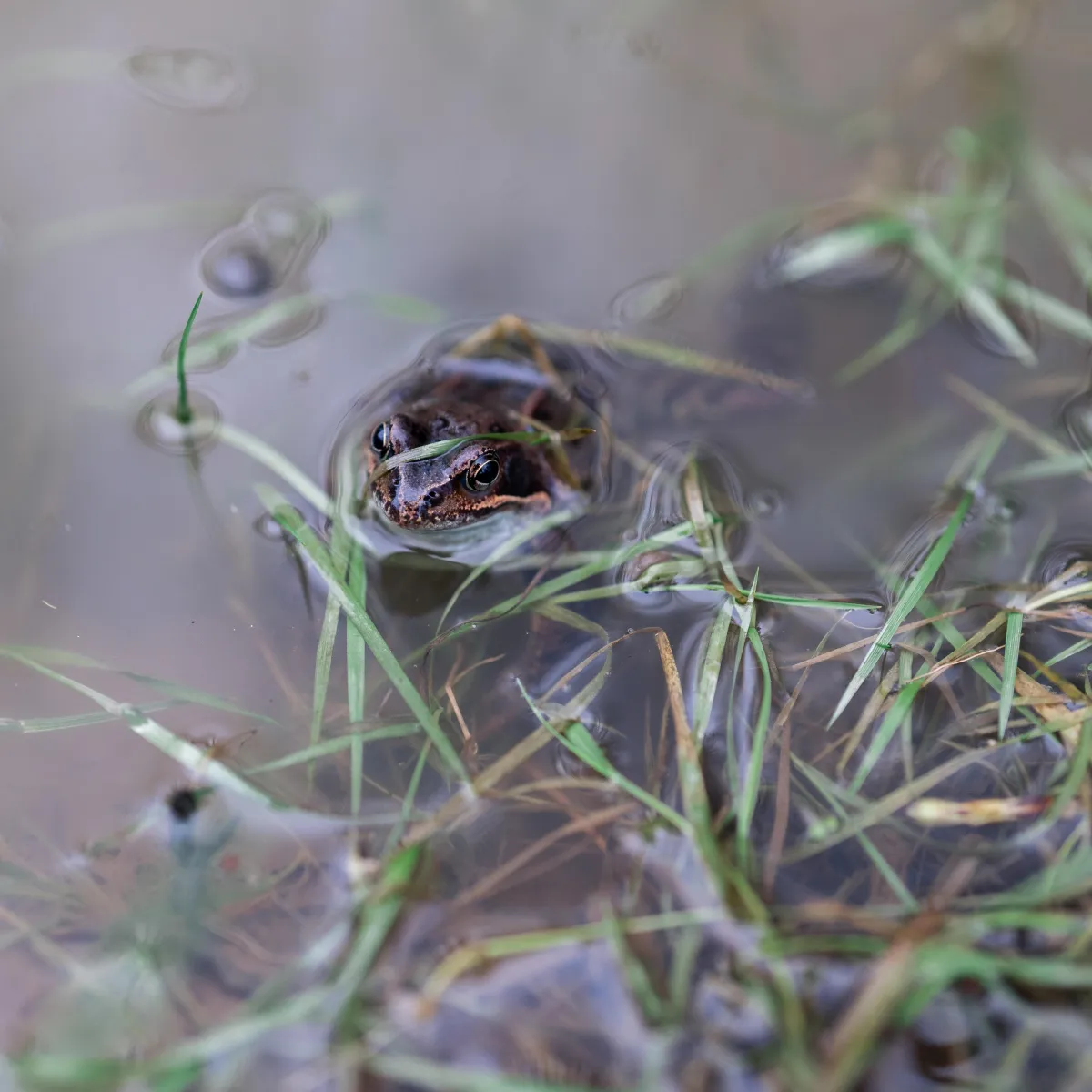


The wildlife ponds were created on the site of a former car park
The workshops were just one of the growing elements of OmVed Gardens’s public programming. Links with the World Food Programme saw the development of Chef’s Manifesto. The chef-led project brings together chefs from around the world to explore how they can help deliver a sustainable food system. As well as food and ecological enthusiasts, creatives flocked to OmVed as music events, exhibitions and performances celebrated the joy of creativity and its relationship to the natural world.
The growing popularity and potential of the Gardens ushered in a new phase of growth. A large part of what was known as the Highgate Bowl had remained unused. Development of this area known as the Contractor’s Yard would allow OmVed Gardens to provide year round access to community groups, artists and visitors. Charlotte Harris and Mark Stevens of HASA worked with Paul Gazerwitz to design a series of buildings sympathetic to the landscape. A hilltop village with an improved events space, a seed library, kitchen and toilet block were proposed as part of a new master site plan developed by HASA. Planning permission for the landscape led project was granted in July 2020.
Charlotte Harris of HASA Architects said: “Our design response grew out of meticulous research into agricultural architecture, particularly the study of the farmstead in the landscape. The new structures, which will replace a number of existing wooden chalets, are designed to ’sit carefully’ within the site’s topography and respond sensitively to the surrounding landscape.”
Following the dissolution of HASA, OmVed Gardens shared this vision with Piers Smerin of Smerin Architects. He added a large greenhouse to the original plan, made some necessary changes to building design and layout as the shape of the site developed and received planning permission for the updated plans in October 2020.
In May 2025 OmVed Gardens completed the site transformation with the addition of a cluster of buildings. The new hub for permaculture, biodiversity and community sits within the existing gardens and is spread across a series of buildings that follow the life-cycle of edible plants. From seed through germination and growth to being harvested and prepared for the plate, the complex of new buildings at OmVed Gardens provide spaces tailored to suit the particular needs of each activity. The new spaces include: the Barn - a reimagining of a multipurpose events space, the Kitchen complete with accessible rooftop garden and café, a dedicated Seed Library and the Greenhouse, a striking double height space maximizing passive solar gain and natural ventilation.

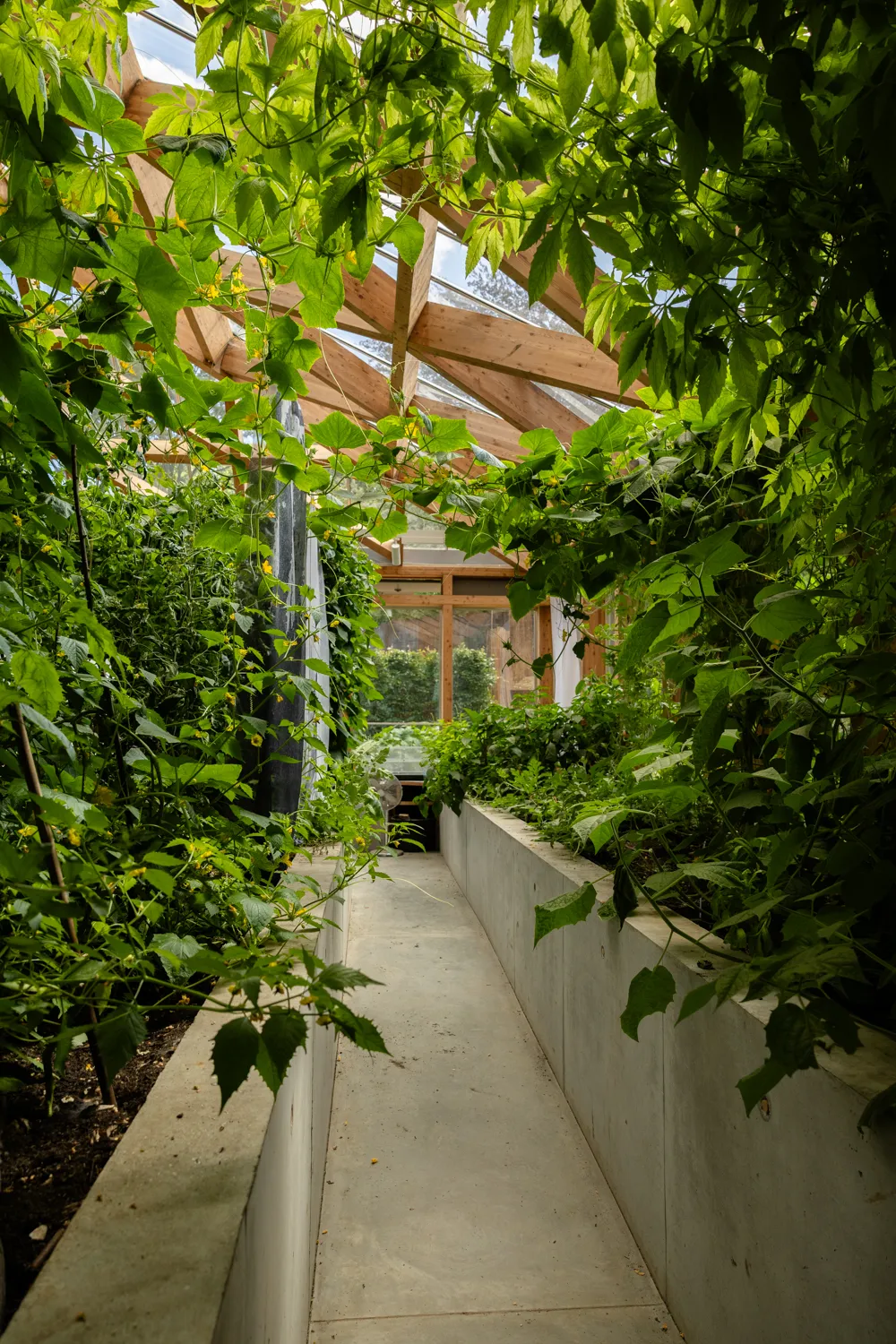


The site transformation in May 2025
Architect Piers Smerin said; “The project has been a once in a lifetime opportunity to design a series of buildings that work in harmony with their landscape setting rather than one being subordinate to the other as is so often the case. Working with Paul Gazerwitz and his team to achieve this has been a terrific experience and it has been fascinating to see the design of both the buildings and landscape change in response to each other as the final designs evolved. It has also been a great opportunity to show off how much you can do with timber as a constructional material whether creating the lofty vaulted spaces within the buildings, supporting the roof garden over the kitchen space or creating a bridge to connect the roof garden to the landscape beyond.
Collaborating with structural engineers Lyons O’Neill and the specialist timber fabricators Carpenter Oak who made and erected the timber frames has resulted in some innovative, elegant and subtly beautiful timber structures that I’m delighted with and hope others will enjoy. Despite the many challenges presented by working on such a steeply sloping site, and with considerable help from the ever resourceful builders Johnson Friel Building, the whole project has been a pleasure from start to finish and it has been a privilege to help such a unique client realise their vision for OmVed Gardens.”


Inside the Barn, OmVed's multipurpose events space
The new hillside landscaping has been designed by Paul Gazerwitz to create a wooded area complementing the existing garden spaces including the wildflower meadow, permaculture vegetable garden, ponds, willow circle and orchard. As it matures, the tree planting will both create an element of discovery approaching the buildings giving a sense of a rural village while the network of paths are designed to facilitate chance meetings and interactions between visitors to the buildings.
OmVed Gardens founder Karen Leason said: “OmVed Gardens’ mission is to create the opportunity to come into relationship with each other and our environment. We focus on advocacy, community and education across food, creativity and ecology to nurture a more beautiful world.
Now the addition of permanent new buildings to OmVed Gardens marks a step change for us. These new spaces will reflect both the ambition, commitment to community and knowledge sharing ideals of the organisation.
Building on the original vision for these spaces and the wider site, architect Piers Smerin has designed a series of welcoming spaces that will allow us to host so many more visitors to the garden, support of work with global food and growing networks and provide a richer experience for visitors of all ages and backgrounds keen to develop a deeper connection with nature.”
The organisation’s name is an expression of the desire to pay more attention, listen and learn from our surroundings. Om is considered a universal vibration encompassing all sounds, and Ved means knowledge. As the landscape takes on its new shape and the buildings provide new purpose and meaning for those visiting, one constant remains. OmVed Gardens keeps growing.