To mark the 60th anniversary of the Highgate Society's Buzz Magazine, our Schools Project Manager Corrie Wingate contributed the following piece, reflecting on OmVed Gardens' work with schools across London. We're sharing it here with thanks to the Buzz.
It’s a typical Monday morning on Highgate High Street. Office workers are heading back after the weekend, cafés are serving their first cappuccinos, and local shops are opening their doors. Just beyond the bustle, however, a class of 30 excited primary aged schoolchildren in bright high-visibility jackets gather outside the gates of OmVed Gardens.
Within moments, they step into a very different world. As they make their way down the winding path, birdsong replaces traffic noise and the shade of the old willow tree offers welcome relief from the summer sun. Many Highgate residents know OmVed Gardens as a former garden centre transformed into a peaceful green oasis, but few realise it has also become an inspiring centre for environmental education.
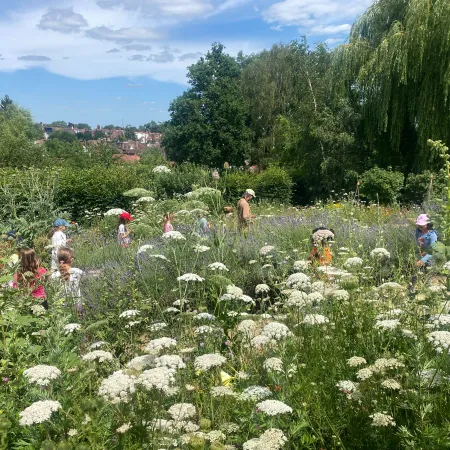
This is not an ordinary school day. Instead of sitting at desks, the children gather in a grassy amphitheatre. Pens are replaced by magnifying glasses, while blackboards give way to blackbirds searching the vegetable beds for worms. As the children explore, they see bees pollinating wildflowers, predatory beetles feeding on rosemary beetles, and ducklings gliding across the ponds. They search beneath logs for insects and learn how worms and fungi help break down plant waste to create healthy soil. Rather than reading about biodiversity in a textbook, they experience it first-hand.
The day's activities continue with making, growing and tasting. Morning snacks include edible flowers, herbs and freshly picked beetroot. Before long, the children discover that a garden is far more than a collection of plants: it is a living ecosystem where every species plays a role.
Children paint with inks made from food waste, plant tomato seeds to take back to school, go on treasure hunts for edible leaves and explore the ponds to identify newts and other freshwater wildlife. Through games, science experiments, creative activities, and sensory experiences, they discover how closely plants, animals and people depend on one another.
These sessions form part of OmVed Gardens' growing education programme, which welcomes pupils from primary and secondary schools throughout the seasons.
State and Independent schools from four North London boroughs have chosen to bring their pupils to experience the living classroom at OmVed gardens, with several schools returning for repeat visits.
However, no two visits are the same. Each workshop is carefully developed to support classroom learning and bring the National Curriculum to life through immersive experiences. Sessions are tailored to the pupil’s ages, abilities, interests and curriculum topics, exploring subjects such as plant science, nutrition, biodiversity, classification and food systems.
At the heart of the programme is a simple belief: meaningful learning happens through curiosity and direct experience. By growing and tasting plants, observing wildlife and making art with natural materials, children begin to see themselves not as separate from nature but as part of it. That sense of connection often becomes the foundation for a lifelong relationship with, and care for, the natural world.
The programme is delivered by a multidisciplinary team that brings together gardeners, ecologists, chefs, food growers and artists. Their different perspectives allow science, creativity and food to sit naturally alongside one another, showing that understanding nature involves much more than biology alone. This interdisciplinary approach is one of OmVed's defining strengths. Ecology is explored alongside art, organic food production alongside biodiversity, and practical making alongside thoughtful discussion. Sustainability is presented not simply as a list of challenges, but as an opportunity for creativity, collaboration and positive action.
The work is increasingly attracting attention beyond Highgate. The education team has recently been invited to advise on the development of an education programme for the new Clore Garden classroom at Tate Britain. This October, the team will deliver a workshop for local Year 5 pupils at the British Library, reflecting growing recognition of its creative approach to environmental education. While firmly rooted in Highgate, these partnerships with schools and leading cultural organisations are helping to share the programme with wider audiences.
As environmental challenges become ever more pressing, opportunities for children to spend time outdoors and develop meaningful relationships with nature have never been more valuable. The true success of programmes like these cannot be measured simply by attendance figures alone, but by the lasting impact they leave. It can be seen in the excitement of a child tasting vegetables picked straight from a plant, discovering a stag beetle beneath a log, or asking questions long after the visit has ended.
For many children, a day at OmVed Gardens is a school trip that invites them to slow down, observe, explore and understand the living world around them. As they head back through the gates to the bustle of HighgateHigh Street, it is not uncommon to hear excited voices calling out, “That was the best school trip ever!" It is a simple remark, but one that captures the lasting value of a place where curiosity is nurtured, creativity flourishes and a lifelong relationship with nature can begin.
OmVed's school sessions are open to every school in London. If you'd like to bring your pupils to learn, dig, create and explore in the garden, visit our school's page to learn more and register your interest.